Custom Software vs. Off-the-Shelf (vs. Spreadsheets): Which Is Right for Your Business?
Custom software vs. off-the-shelf SaaS or spreadsheets: compare the 3-year cost, speed and control, then decide with a simple matrix you can fill in today.
How much does custom software cost in 2026? Price ranges by project type, US vs nearshore rates, pricing models and hidden costs, so you can compare quotes.
How much does custom software cost? In 2026, as an orientative range, a simple internal system (inventory, orders, customers) costs about $25,000 to $75,000 with a US agency, an MVP of a new product $50,000 to $150,000, and a mobile app with a web admin panel $100,000 to $300,000. A nearshore team in Latin America usually builds the same thing for roughly half. Large platforms with many user types, integrations and several apps start in the low six figures and go up from there.
Asking what custom software costs is like asking what a house costs: it depends on how many rooms, where it is and what it’s built with. This guide explains what drives the price, how agencies charge, what costs show up after launch and how to get quotes you can actually compare. It’s written for business owners and operators, not developers.
These ranges are orientative. They’re not an official rate card and they don’t come from a study. They reflect what it typically costs to build each kind of project with a professional team. A US freelancer may charge less than an agency. A large consulting firm will charge more.
| Project type | Examples | US agency (USD) | Nearshore team (USD) | First version takes |
|---|---|---|---|---|
| Automation or integration | Sync Shopify orders into QuickBooks, read invoices with AI, an automatic weekly report | 10,000 – 40,000 | 5,000 – 20,000 | 2 to 6 weeks |
| Simple internal system | Replace the inventory, orders, customers or scheduling spreadsheet | 25,000 – 75,000 | 10,000 – 35,000 | 4 to 8 weeks |
| MVP of a new product | A web platform to sell your service, a customer portal | 50,000 – 150,000 | 25,000 – 75,000 | 6 to 12 weeks |
| Mobile app with web admin | Booking, ordering or delivery app on the App Store and Google Play | 100,000 – 300,000 | 50,000 – 150,000 | 2 to 5 months |
| Large platform | Many user types, payments, ERP integrations, several locations | 300,000+ | 150,000+ | 4 months or more, in phases |
If your project doesn’t fit any row, that’s fine. The table is there to help you place yourself. If you were expecting to pay $5,000 for a delivery app with online payments, you now know the conversation will be a different one.
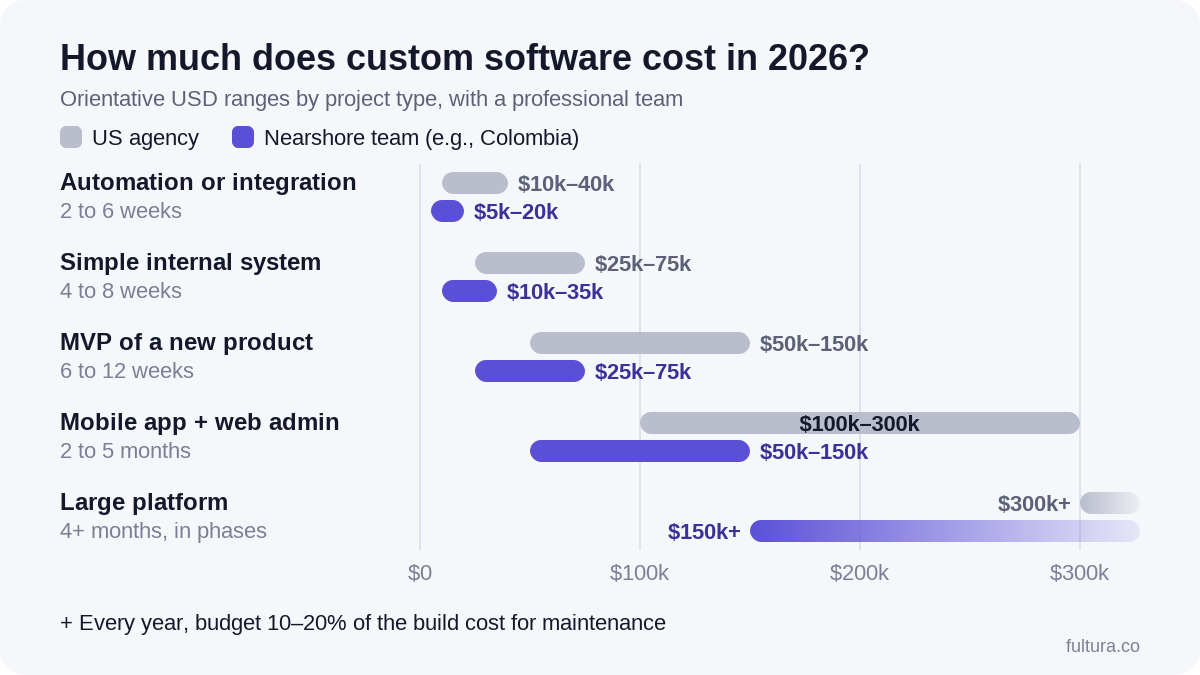 Orientative USD ranges and time to a first version, by project type and team location.
Almost every quote comes from one simple formula: hours of work × the hourly rate of the people doing it. The scope sets the hours. Where the team is located sets most of the rate.
| Team | Typical rate (orientative, USD/hour) | Time zone overlap with the US | Best for |
|---|---|---|---|
| US agency | 150 – 250 | Full | Projects that need people on-site or US-only staff |
| US freelancer | 75 – 150 | Full | Small, well-defined jobs |
| Nearshore team (Latin America) | 50 – 100 | Full or near-full | Ongoing builds where you want daily contact at lower cost |
| Offshore team (Asia, parts of Eastern Europe) | 25 – 60 | Little or none | Well-specified work that doesn’t need real-time back and forth |
Rates vary a lot inside each band, depending on seniority and the type of work. Treat them as a starting point for questions, not a price list.
Nearshore means a team in a nearby country with overlapping working hours. For US companies, that’s usually Latin America. Colombia, where we’re based, is on UTC-5, the same as US Eastern Standard Time. You can have a call at 10 a.m. your time and see the fix the same afternoon.
Nearshore fits when you want senior engineers you can talk to during your workday, and when your budget doesn’t stretch to US agency rates. It doesn’t fit when you need someone physically in your office, when a contract or regulation requires US-based staff, or when your whole budget is a few thousand dollars. In that last case, an off-the-shelf tool or a freelancer is usually the better call.
According to the US Bureau of Labor Statistics, the median annual wage for software developers was $135,980 in May 2025. That’s before payroll taxes, benefits, equipment and recruiting. And one developer is rarely enough: someone also has to design, test and manage the work. In-house makes sense when software is the core of your business and you’ll keep building for years. We compare the three options in detail in freelancer vs agency vs in-house team for software development.
Anything that adds hours adds cost. These are the usual suspects.
Besides how much, it matters how you’re billed. There are three common models, and each splits the risk differently.
| Fixed price (per project or per phase) | Hourly (time and materials) | Monthly (dedicated team or retainer) | |
|---|---|---|---|
| How it works | Scope and price are agreed before starting | You pay for hours worked each week or month | You pay a flat monthly fee for a team or a block of hours |
| You know what you’ll pay | Yes | No, only an estimate | Yes per month, but not how many months |
| If the project changes | The change and its price are agreed | It adjusts on its own, and the bill grows | It’s reshuffled within the fee |
| Who carries the risk of overruns | The vendor | You | Shared |
| Works best for | Projects with a clear scope | Very uncertain or exploratory work | Ongoing improvements after launch |
A fixed price for an entire large project has a catch. If the scope is fuzzy, the vendor protects itself by padding the price, or you end up arguing about what was included. That’s why many teams, ours included, work with a fixed price per phase: one part is quoted and delivered, you try it, and that tells everyone how to scope the next one.
Picture a wholesale distributor that takes orders by phone, text and email and types them into a spreadsheet. It wants its sales reps to log orders from their phones and the warehouse to see them instantly, with orders flowing into QuickBooks.
With a fixed price per phase from a nearshore team, the proposal might look like this:
Total: $34,000. But the company only commits to the first two phases ($26,000) and decides on the third once it’s using the system.
Billed hourly, suppose a rate of $75 an hour (a number for the example, not a benchmark). If the initial estimate is 350 hours, the expected cost is $26,250. If changes come up and the project ends at 450 hours, the bill is $33,750. At 550 hours, it’s $41,250. None of those numbers is bad on its own. The point is that with this model you don’t know which one you’ll get until the end.
For comparison, the same 350 hours at a US agency rate of $175 an hour would be $61,250. Same software, very different invoice. That gap is the main reason US companies look at nearshore teams.
The build isn’t the only thing you’ll pay for. Ask about these from day one:
If you’re comparing options and want a number for your case, book a free 30-minute call with us. We’ll review what you need and send a written proposal with a fixed price for each phase and these monthly costs included, so you can compare with clear numbers. If we think you’re better off with an existing tool, we’ll say so.
Building your own isn’t always the right move, and it’s better to know before you spend. You probably shouldn’t build when:
The same goes for common problems like stock tracking. Many small businesses do fine with an existing tool. See our guide to the best inventory management software for small business before you pay for a custom build.
On the other hand, custom software does make sense when the way you work is what sets you apart, when you’re paying for several subscriptions that don’t talk to each other, or when the spreadsheet has hit its limit and nothing on the market fits your operation.
A quote is only as good as the information you give the vendor. Write “I want an app like Uber, how much?” and you’ll get a huge range or a made-up number. Here’s what to do instead:
Don’t compare only the total. Two proposals at the same price can include very different things, and the cheaper one can end up costing more if it leaves out design, testing, app store release or support. Put them side by side and check scope, phases and deliverables, timeline, monthly costs, warranty and code ownership.
Be wary of a quote far below the others with no clear explanation, a vendor who asks nothing about your business before naming a price, and a demand for 100% upfront.
Many small businesses don’t need a full system. They need to take one repetitive task off their team’s plate: answering common customer questions, pulling invoice data into a spreadsheet, drafting quotes. That kind of project usually sits in the first row of the table: smaller, faster, and with a return that’s easy to measure. Watch for one cost the table doesn’t show: AI services charge per use, so ask for an estimate of the monthly bill at your volume of messages or documents. If that’s your path, read AI automation for small business: 10 processes worth automating.
Well-planned custom software isn’t money that disappears. It’s a tool that works for your business every day. What makes it expensive is almost never the hourly rate. It’s building things you didn’t need, or building without knowing what for.
As an orientative range, a simple internal system (inventory, orders, customers) costs about $25,000 to $75,000 with a US agency and $10,000 to $35,000 with a nearshore team. The price depends mostly on the number of screens, user roles and integrations, and on how clear the scope is.
A mobile app with a web admin panel usually starts around $100,000 with a US agency and around $50,000 with a nearshore team, and goes up with payments, maps, chat or integrations. On top of that, as of publication Apple charges $99 a year for its developer program and Google Play charges a one-time $25 fee.
A fixed price per phase gives you certainty about what you'll pay and forces a clear scope. Hourly billing is more flexible when the project changes a lot, but the final cost stays open and you need to watch progress closely.
Besides hosting and third-party services, plan on setting aside about 10% to 20% of the original build cost each year for fixes, updates and small improvements. If you keep adding features, it will be more.
A useful first version usually takes 6 to 12 weeks. Large projects with many integrations or several apps can take several months, and they're best launched in phases.
Usually yes: nearshore teams in Latin America tend to charge roughly half of what a US agency charges for comparable work, while working in the same or close time zones. The savings only hold if the team is senior and communicates well, so judge them on their work, not just the rate.
In a free 30-minute call we go over what you need. Then we send you a written proposal with a fixed price for each phase and the monthly running costs included. If an off-the-shelf tool or a freelancer fits you better, we'll tell you.