Freelancer vs Agency for Software Development: How to Choose (and When to Hire In-House)
Freelancer vs agency for software development: compare US costs, risk and control against an in-house team or nearshore, plus red flags and a hiring checklist.
fultura.co Team12 min read
If you’re planning software for your business, the freelancer vs agency question shows up fast. The short answer: a freelancer fits small, well-defined work that isn’t critical; a software development agency fits systems your operation depends on, that need several skills and can’t hinge on one person; and an in-house team only makes sense when software is the heart of your business and you’ll need changes all year. A nearshore agency sits in the middle: an agency’s process and continuity at rates closer to a freelancer’s.
The hourly rate is not what should decide it. Risk is: what happens if the person disappears, who keeps the code, and how much of your own time goes into managing the work. Below we compare all four options on cost, risk and control, walk through an example with numbers, and finish with the questions to ask before you sign with anyone.
Freelancer, agency or in-house team: what you’re actually hiring
Freelancer: one person, per project
A freelancer is an independent developer. You pay by the hour or by the project, and they do everything: understand what you need, write the code, test it and ship it.
The upside is speed and cost. The limit is that it’s one person. They get sick, take vacations, land a full-time job or get busy with other clients.
Software development agency: a team that works for you
An agency gives you a team: someone who understands the business and runs the project, designers, developers and someone who tests. You talk to one or two people, and they coordinate the rest.
It costs more per hour than a freelancer, but you’re buying more than coding hours. You get a process, continuity if someone on the team leaves, and a company that answers for the result.
Nearshore agency: a team in your time zone, at lower rates
Nearshore is still an agency, just based in a nearby country. For US companies that usually means Latin America. Colombia, for example, is on UTC-5: the same as US Eastern time in winter and Central time in summer. You get real-time meetings and same-day answers, which is the main difference from offshore teams 10 or 12 hours away.
Rates are lower mainly because of local cost of living, not simpler work. Check the same things as with any agency: seniority, English, process and code ownership.
In-house team: your own employees
You hire developers as employees. They learn your business deeply and work only for you.
This gives you the most control, but it’s the slowest to set up and the most expensive to keep. Beyond salaries, you pay benefits, recruiting and, above all, someone who can lead a technical team. If no one in your company can judge a developer’s work, it’s hard to know whether the team is on track.
Freelancer vs agency vs in-house: side-by-side comparison
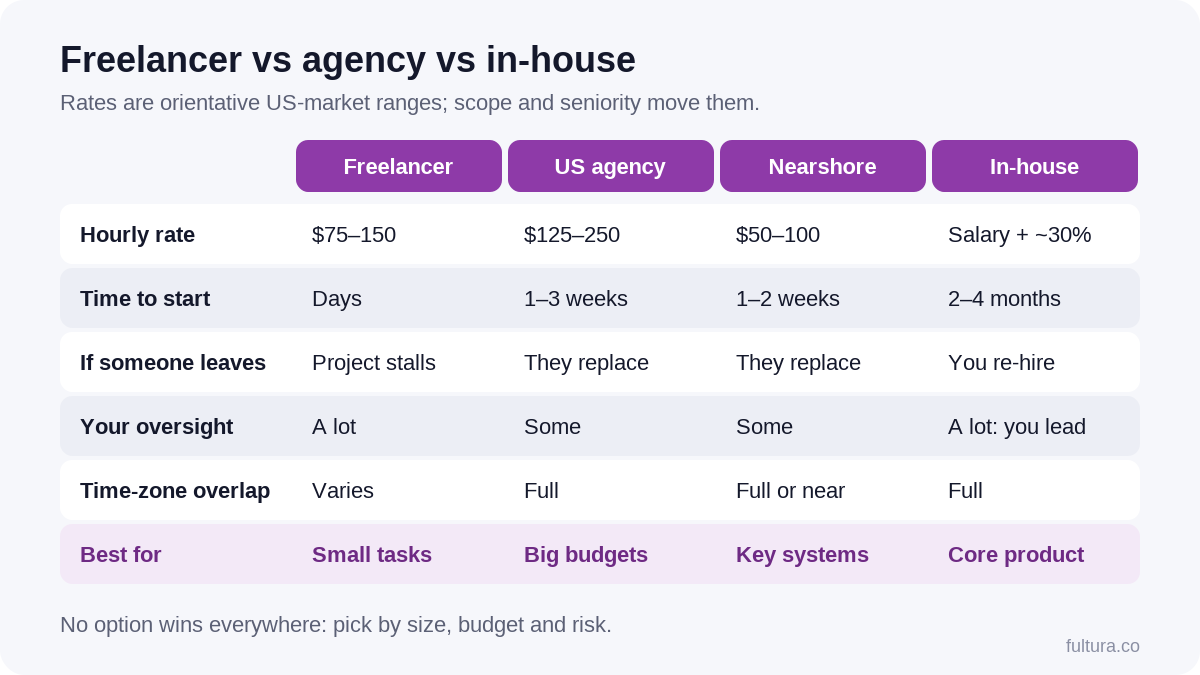
The differences that matter most for a small or mid-sized business:
Freelancer
US agency
Nearshore agency
In-house team
Hourly cost
Lowest to medium
Highest
Medium
Looks low, but adds benefits, recruiting and management
Commitment
Per project or hours
Per project or monthly
Per project or monthly
Employment, long term
Time to start
Days
1–3 weeks
1–2 weeks
Months (recruit, hire, onboard)
Skills available
One person’s
Design, development, testing, infrastructure
Design, development, testing, infrastructure
Whatever you manage to hire
If someone leaves
Project stalls or is lost
Agency replaces them
Agency replaces them
You lose knowledge and re-hire
How much you manage
A lot
Some
Some
A lot: you lead the team
Time-zone overlap
Varies
Full
Full or near-full
Full
Who answers for the result
The freelancer, if still around
The company, under contract
The company, under contract
You
Best for
Small, contained tasks
Critical systems with a large budget
Critical systems with a tighter budget
Software that is the core of the business
No column wins on everything. The useful question isn’t “which is best?” but “which is best for this project, this budget and this level of risk?”
Each option wins on something different.
How much does each option cost? (and what’s not in the quote)
Rates vary a lot with seniority, tech stack, location and how much of the project the price covers. Take these hourly ranges as orientative, not as a market survey:
Option
Orientative hourly rate
What moves it
US freelance developer
~$75–150
Seniority, niche skills, city, demand
US software agency
~$125–250 (blended)
Agency size, brand, whether strategy and design are included
Nearshore agency (Latin America)
~$50–100
Seniority, country, team mix
Offshore agency (far time zones)
~$25–50
Seniority, how much you manage the overlap yourself
In-house developer
Salary plus ~30%
Market, seniority, benefits package
For in-house, two public numbers help. The U.S. Bureau of Labor Statistics puts the median software developer wage at roughly $135,000 a year, and benefits make up about 30% of total compensation costs for private employers (both from BLS data as of publication). So a median developer costs close to $190,000 a year before recruiting, equipment and management.
For a full breakdown of pricing models and project ranges, see how much custom software costs in 2026. What follows is what makes up the real cost of each option, because that’s where most people get it wrong.
What you pay with a freelancer
Their hours or the project fee. This is what the quote shows.
Your time managing them. You’ll define what gets built, review it, test it and chase progress. If you’re the owner, that time is expensive.
The risk of an unfinished project. If they leave halfway, another developer has to understand code they didn’t write. Fixing it often costs more than starting over.
What they don’t know how to do. If they’re a good developer but don’t design, or don’t handle servers, someone has to fill those gaps.
What you pay with an agency (US or nearshore)
The project fee or monthly retainer. It’s higher per hour because it covers several people and project management.
Less of your time. A good agency organizes the work, tests it and shows you progress. You make decisions; you don’t manage each developer.
The agency’s margin. Part of what you pay keeps the company running. In return, someone is accountable if things go wrong.
With nearshore, a vetting step. Check English, overlap hours and references more carefully than you would with a local shop you can visit.
What you pay with an in-house team
Salaries, benefits and payroll taxes for each person, every month, busy or not.
Recruiting. Finding good developers takes time, and a bad hire is costly.
Technical leadership. Someone has to decide how things get built, review quality and set priorities.
Turnover. When a developer leaves, the knowledge of what they built leaves too.
A worked example with numbers
Here’s a hypothetical case. The figures are round numbers to show the logic, not quotes: swap in the bids you get and run the same math.
A regional distributor wants an internal system for taking orders and tracking deliveries, which today lives in spreadsheets and text messages. They estimate about 4 months of build time, then small changes now and then.
Freelancer. About $12,000 a month for 4 months: $48,000. The freelancer doesn’t design, so they add a designer for $6,000. Visible total: $54,000. On top of that, the owner expects to spend about 8 hours a week managing and testing, roughly 140 hours over the project, plus the risk that the freelancer walks away midway.
US agency. About $30,000 a month for 4 months: $120,000, with design, testing and deployment included and a demo every week. The owner spends about 2 hours a week reviewing and deciding.
Nearshore agency. About $18,000 a month for 4 months: $72,000, with the same scope as the US agency, weekly demos and meetings during US business hours. The owner also spends about 2 hours a week.
In-house team. Two developers at a fully loaded cost of about $16,000 a month each. Recruiting takes about 3 months, and once the system is done they stay on payroll. The first year comes to about $288,000 (9 months of two people), before recruiting fees, for a system that was ready in 4.
In-house makes no sense here: it means paying all year for a few months of work. The real choice is between the freelancer and an agency, and it comes down to one question: how much is it worth to you that the project doesn’t collapse halfway and that you don’t have to run it? Between the freelancer and the nearshore agency, the gap is $18,000 plus about 100 hours of the owner’s time. If the system runs daily order fulfillment, that’s cheap insurance. If it’s a side tool, maybe not. The US agency buys the same insurance for another $48,000, which can make sense if you need people on-site or prefer a local contract.
The math flips if software is your product, say an app you sell to customers and will improve every month for years. That’s when an in-house team starts to pay off.
When to hire a freelancer, an agency or an in-house team
Hire a freelancer if…
The work is small and well defined: a website, a change to a system you already have, a single integration.
If it’s late or fails, your business keeps running.
You have time to manage and test, or someone on your team with some technical background.
You know them through a direct referral and have seen their work running.
Hire an agency if…
The system is important to daily operations: orders, inventory, invoicing, customer service.
You need several skills at once: understanding the process, design, development, testing and deployment.
No one in-house leads technical teams, and you don’t want to become a manager of developers.
You want a contract with a company that answers for the result.
Choose nearshore over a US agency if…
Budget matters and you still want a full team, not one person.
Real-time collaboration matters: live demos, quick calls, same-day fixes.
You’re comfortable working remotely with a team you’ll rarely meet in person.
Nearshore is not the right fit if you need people on-site, if your contracts or regulations require US-based staff or US persons, or if the task is so small that a trusted local freelancer can do it in a week.
Build an in-house team if…
Software is your business or your main edge over competitors.
You’ll need constant changes for years, not a project with a start and an end.
You have, or can hire, an experienced technical lead.
You can carry payroll through slower months.
A middle path works well: start with an agency to build the first version, with the code in your name, and hire in-house later, once the system works and you know which roles you need. The new team inherits something useful instead of starting from scratch.
If you’re at that point and unsure which way to go, book a short call and we’ll look at your project and tell you which option makes the most sense. And before you decide who builds it, make sure you actually need something custom: sometimes an existing product solves the problem. We compare both in custom software vs off-the-shelf.
When NOT to hire an agency
We’re an agency, so we say this from experience: we’re not always the best option.
The project is very small. To update website copy or connect a form, an agency is overkill. A trusted freelancer will do it faster and cheaper.
You don’t know yet what you want. If the problem isn’t clear, any vendor will build on guesses. First get the process in order, even on paper or in a spreadsheet, and prove it works.
An existing product already does it. Paying to build what a monthly subscription gives you rarely makes sense. If you need to track stock, for example, look at our roundup of the best inventory management software for small business before commissioning one.
Software is your core and you can afford a team. In the long run, that knowledge should live inside your company.
Red flags when hiring a developer or agency
Whether it’s a freelancer, an agency or a job candidate, these should make you stop:
A fixed price with no questions about your business. If they haven’t understood the problem, the price is a guess, and you’ll pay the difference later.
Nothing to see until the end. If three months in you haven’t seen a working screen, you don’t know whether the project is on track.
The code, hosting or domain in their name. If you end the relationship tomorrow, you should be able to take everything with you.
No live projects to show. Polished screenshots aren’t the same as a system someone uses every day.
Everything promised fast, cheap and perfect. In software, when all three come together, one of them usually doesn’t happen.
No talk about what happens after launch. Every system needs fixes, adjustments and updates. If no one brings it up, you’ll be on your own.
Most of the payment up front. A healthy setup ties payments to progress you can see and test.
Questions to ask before hiring a developer or agency
Bring this list to every conversation. The answers tell you more than the quote.
What similar projects have you built, and can I see them running? Even better if you can talk to someone who uses them.
Who exactly will work on my project? With an agency, ask whether the people in the sales meeting are the ones who will build it.
How often will I see progress? Healthy is being able to see and try working software every week or two.
Who will own the code, hosting and domain? The right answer: you, from day one.
How do you charge? Fixed price, hourly or monthly. Ask what happens when the scope changes midway, because it will.
What’s included and what isn’t? Design, testing, deployment, hosting, training, documentation.
What happens after launch? Warranty, support, what a change costs and how fast you respond.
What if I want to switch vendors? You should be able to take the code, and another team should be able to understand it.
How will we communicate, and during which hours? Who you talk to, on which channel, and how fast they reply. With nearshore or offshore teams, ask how many hours overlap with yours.
What do you need from me? A good vendor will ask for time to understand your process and to review progress. If they say they need nothing, be careful.
If your idea includes AI, add one more: what data the system will use and where it’s stored. Our guide to AI automation for small business covers what’s worth automating and what isn’t.
How fultura.co can help
We’re a nearshore custom software agency based in Colombia. We build internal systems that replace spreadsheets, web and mobile apps, MVPs and AI integrations for US small and mid-sized businesses, with senior engineers working in your time zone. You see working software in a demo every week, and you own the code: if you later want to move to another vendor or your own team, you take it with you.
Still unsure whether your project calls for a freelancer, an agency or your own team? Tell us what you need. If we’re not the right fit, we’ll say so.
Frequently asked questions
Is it better to hire a freelancer or an agency for software development?
It depends on the size and risk of the project. A freelancer fits small, well-defined work that won't stop your business if it slips. An agency fits systems your operation depends on, that need several skills (design, development, testing) and can't rest on one person.
How much does it cost to hire a freelance software developer in the US?
Experienced US freelancers commonly charge somewhere around $75 to $150 an hour, depending on seniority, tech stack and location. The hourly rate is usually the lowest of your options, but the real cost also includes the time you spend managing them and the risk of an unfinished project.
When does it make sense to build an in-house development team?
When software is the core of your business and you'll need changes all year, for years. For a system you build once and then maintain, an in-house team usually costs more than hiring outside, because you pay salaries and benefits even in slow months.
What is nearshore software development?
Nearshore means hiring a team in a nearby country with overlapping working hours. For US companies that usually means Latin America, where teams in places like Colombia work in US time zones at lower rates than US agencies.
How do I know if a software agency is trustworthy?
Ask to see real projects that are live and in use, who exactly will work on yours, how often you'll see working software, and who will own the code. Be wary of a fixed price given without questions about your business, or of not seeing any work until the end.
Who owns the code when I hire a developer or agency?
Whoever the contract says. Before you sign, put in writing that the code, hosting accounts and domains are in your name, and that you get access to the code repository from day one, not at the end.
freelancer vs agencyhiring software developerssoftware development agencyin-house development teamnearshore software development
Not sure if your project needs a freelancer, an agency or your own team?
Tell us what you're building in a free 30-minute call. We'll give you an honest recommendation, even if it's not hiring us.
How much does custom software cost in 2026? Price ranges by project type, US vs nearshore rates, pricing models and hidden costs, so you can compare quotes.
Custom software vs. off-the-shelf SaaS or spreadsheets: compare the 3-year cost, speed and control, then decide with a simple matrix you can fill in today.
AI automation for small business: 10 processes worth handing to AI in 2026, what each one needs, rough costs and payback, and what you should not automate.
 Each option wins on something different.